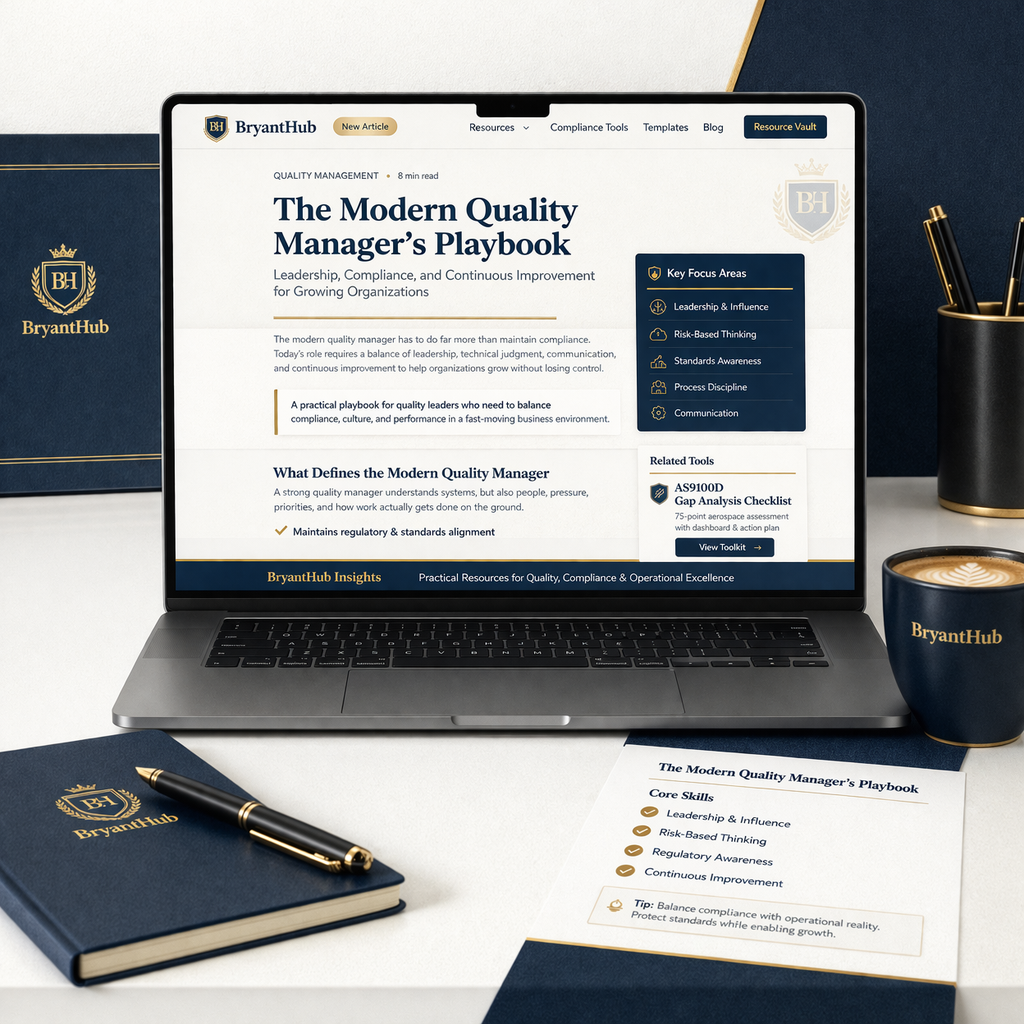
The Modern Quality Manager’s Playbook
The modern quality manager has to do far more than maintain compliance. Today’s role requires a balance of leadership, technical judgment, communication, and continuous improvement to help organizations grow without losing control. This quality manager’s playbook outlines the core skills, mindset, and priorities needed to lead a strong quality function in a fast-moving business environment.
For many organizations, quality is still treated too narrowly. It is often seen as a documentation function, an audit function, or a corrective action function. In reality, strong quality management sits much closer to operational leadership. A capable quality manager helps the business reduce risk, improve consistency, build trust, strengthen accountability, and create the conditions for sustainable growth.
The challenge is that modern quality leaders must operate in two directions at once. They have to protect standards, discipline, and compliance while also helping the business stay practical, efficient, and commercially responsive. That balancing act is what separates a reactive quality department from a high-performing one.
What Defines the Modern Quality Manager
The modern quality manager is not just a keeper of procedures. The role is broader, more visible, and more commercially important than that. A strong quality manager understands systems, but also understands people, pressure, priorities, and how work actually gets done on the ground.
That means the role now includes:
- maintaining regulatory and standards alignment
- building practical control systems
- supporting audit readiness
- improving process consistency
- driving corrective action and root cause discipline
- influencing management behavior and team culture
- balancing compliance expectations with operational reality
The best quality managers do not create bureaucracy for its own sake. They create order, clarity, and confidence. They know which controls matter most, where the risks sit, and how to help people follow the system without making the business harder to run.
Why Technical Knowledge Alone Is Not Enough
Technical knowledge still matters. A quality manager needs to understand standards, documentation structure, audit logic, corrective action methods, evidence expectations, and process controls. But technical knowledge alone is no longer enough.
A quality leader can know every clause in a standard and still struggle if they cannot influence other departments, communicate clearly, or gain management support. Quality problems are rarely solved by documents alone. They are solved when people understand expectations, follow disciplined processes, and take ownership of the system.
This is why a real quality manager’s playbook must go beyond compliance detail. It has to include leadership, judgment, prioritization, and the ability to connect quality goals to business performance.
Core Skills Every Quality Manager Needs
Leadership and Influence
Quality managers often have responsibility without direct control over every department they affect. That means influence is essential. They need to guide decisions, challenge weak practices, and create alignment without relying only on authority. Good quality leaders are calm, credible, consistent, and able to make people take the system seriously.
Risk-Based Thinking
Not every issue carries the same level of consequence. Strong quality managers know how to distinguish between minor imperfection and meaningful risk. They focus attention where control failure could affect product quality, compliance, customer confidence, safety, or operational stability. This allows the quality function to stay practical and proportionate.
Regulatory and Standards Awareness
Quality managers need a working command of the standards and frameworks that govern their environment. That includes not only the wording of requirements, but also the practical expectations behind them. They should understand what auditors will look for, what evidence supports conformity, and where organizations commonly fall short.
Process Discipline and Continuous Improvement
Good quality leadership is not only about preventing failure. It is also about improving how the business operates. A strong quality manager identifies recurring weaknesses, tightens controls, improves clarity, and helps teams build more reliable routines over time. Process discipline is what creates consistency. Continuous improvement is what prevents stagnation.
Communication Across Departments
Quality cannot operate in isolation. The quality manager has to speak to operations, leadership, engineering, procurement, maintenance, training, and support functions in language they understand. That means translating quality expectations into operationally useful terms and making improvement work feel relevant rather than abstract.
Why Every Team Needs a Quality Manager Playbook
This quality manager’s playbook is designed to help leaders balance compliance expectations with practical operational control.
A strong quality manager’s playbook gives growing organizations a clearer framework for leadership, accountability, and continuous improvement.
In practice, a quality manager’s playbook should support better decision-making, stronger systems, and more consistent cross-functional execution.
The best quality manager’s playbook is not theoretical. It should help teams protect standards while still enabling growth and day-to-day usability.
How Quality Managers Balance Compliance and Growth
One of the hardest parts of the role is helping a business grow without losing control. As companies expand, add new people, increase output, or take on more complex requirements, informal habits start to break down. More work means more variation, more pressure, and more opportunity for inconsistency.
This is where the quality manager becomes especially important. They help the organization scale with discipline. They establish controls that are clear enough to follow, strong enough to hold up under pressure, and practical enough to support day-to-day work.
That balance matters because poor quality systems create drag in both directions. Too little control increases risk, rework, and audit exposure. Too much unnecessary control slows the business, frustrates teams, and weakens adoption. The quality manager’s job is to build the middle ground: a system that is controlled, usable, and trusted.
For teams building stronger systems, structured tools like an AS9100D Gap Analysis Checklist can help turn high-level quality goals into practical action.
Building a High-Performing Quality Culture
Culture is where quality either becomes real or stays theoretical. A company can have procedures, forms, and audit schedules in place and still perform poorly if people do not respect the system. High-performing quality cultures are built through consistency, visibility, and leadership behavior.
That usually means:
- clear expectations
- consistent follow-up
- visible accountability
- timely corrective action
- strong management participation
- practical training and reinforcement
Culture also improves when quality is positioned as a business-strength function, not just an enforcement function. People are more likely to engage when they understand that quality protects performance, customers, reputation, and growth, not just audit outcomes.
Quality managers who build strong cultures usually do three things well: they make expectations clear, they keep standards consistent, and they help teams understand why the controls exist.
Common Mistakes Quality Managers Should Avoid
- Overcomplicating the system. A system that is too heavy becomes harder to follow and easier to bypass.
- Focusing only on documentation. Documents matter, but process behavior matters more.
- Reacting only after problems occur. Strong quality management is proactive, not purely corrective.
- Treating audits as the whole job. Audits are one input, not the entire function.
- Failing to build cross-functional support. Quality cannot succeed without buy-in from the wider business.
- Ignoring communication. Good systems fail when people do not understand them.
A mature quality manager’s playbook helps avoid these traps by keeping the role grounded in both control and practicality.
How to Strengthen Your Quality Function
Improving the quality function usually starts with a few honest questions:
- Are the current controls clear, current, and usable?
- Do people understand what is expected of them?
- Are recurring issues being addressed at the root cause level?
- Is management actively supporting the system?
- Are improvement actions prioritized and followed through?
- Is the quality team operating strategically or only reactively?
Once those questions are answered, the next step is to tighten the system in practical ways. That may include better audit planning, clearer document control, stronger corrective action follow-up, more disciplined evidence capture, or better use of structured templates and checklists.
Quality managers working in regulated sectors should also stay aligned with current industry expectations and standard frameworks from bodies such as ASQ and IAQG.
Teams looking to improve operational control can also benefit from practical BryantHub tools such as FOD Prevention Pack resources and structured Internal Audit Templates.
Final Thoughts
The modern quality manager is no longer just a technical gatekeeper. The role sits at the intersection of compliance, leadership, operational control, and continuous improvement. That makes it one of the most commercially important functions in any organization that wants to grow without losing discipline.
A strong quality manager helps create systems that people can follow, leaders can trust, and customers can rely on. That is why a practical quality manager playbook matters. It provides the mindset and operating logic needed to lead quality in a way that is structured, credible, and useful to the wider business.
Organizations that take the role seriously tend to perform better over time. They make fewer reactive decisions, solve problems with more discipline, and build a stronger foundation for sustainable improvement.
Frequently Asked Questions
What does a modern quality manager do?
A modern quality manager leads compliance, process control, improvement planning, audit readiness, cross-functional coordination, and quality culture development across the business.
What skills are most important for a quality manager?
The most important skills include leadership, communication, standards awareness, risk-based thinking, process discipline, and the ability to drive continuous improvement.
Why is quality leadership important in growing companies?
As organizations grow, quality leadership helps maintain consistency, reduce risk, improve customer confidence, and support scalable operations without losing control of core processes.
How can a quality manager improve business performance?
A quality manager improves performance by strengthening systems, reducing recurring issues, improving accountability, supporting better decisions, and helping teams work in a more disciplined way.